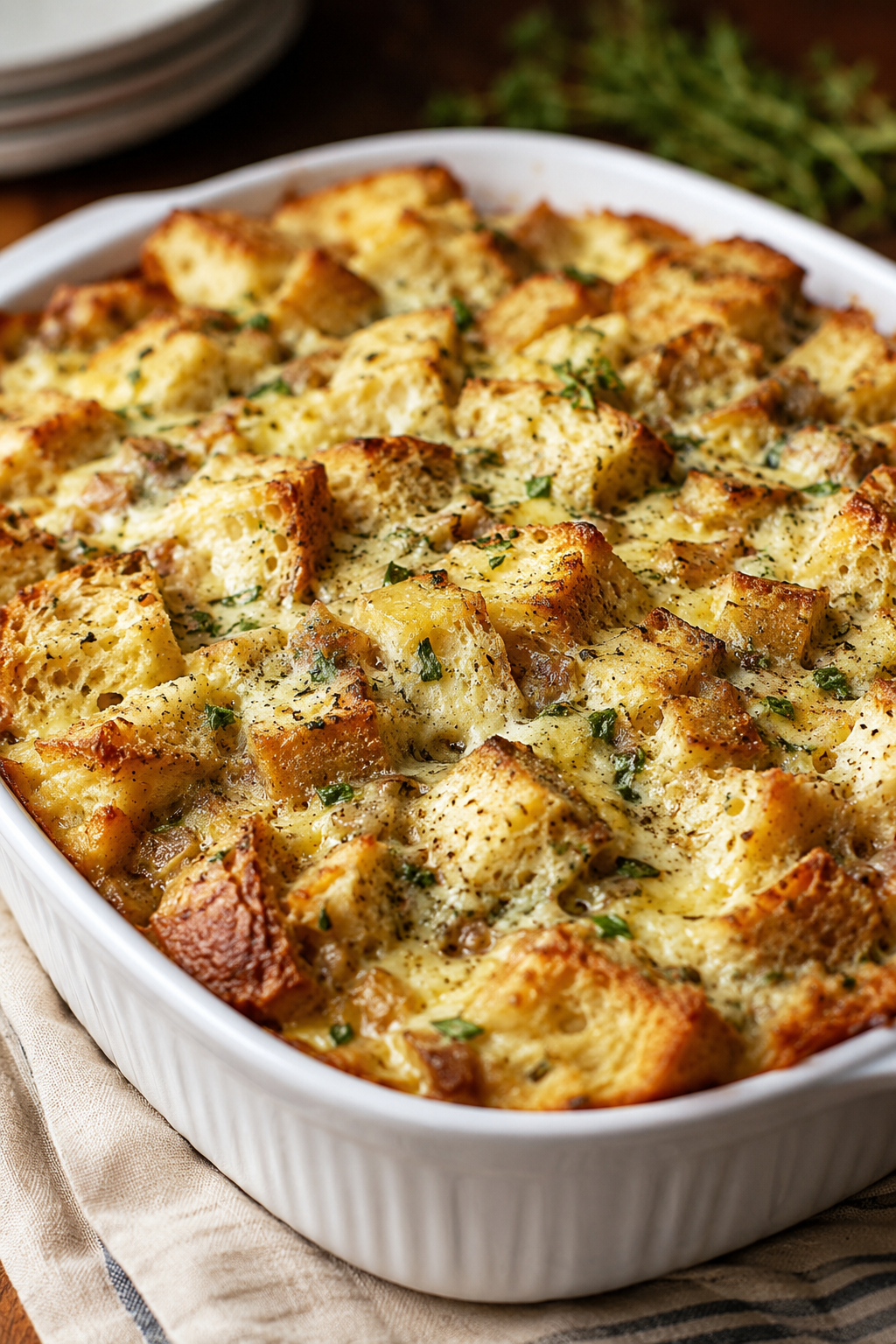
Hey, welcome back! Today we are making something that is going to completely change the way you think about bread pudding forever — Savory Bread Pudding. Most people hear the words bread pudding and immediately think dessert — something sweet, custardy, and comforting with a drizzle of caramel or whiskey sauce over the top. And while that version is wonderful, today we are going in a completely different direction and making a version that is every bit as comforting and satisfying but built entirely around savoury flavours that make it perfect as a main dish, a hearty side, or the centrepiece of a brunch table that genuinely impresses everyone at it.
Imagine thick, torn pieces of crusty bread soaked in a deeply savoury custard made from eggs, cream, and a generous amount of cheese, packed with sautéed vegetables, smoky bacon or pancetta, caramelised onions, fresh herbs, and more cheese melted through every layer — then baked until the top is golden and slightly crispy while the interior is rich, custardy, and deeply flavourful. This is savory bread pudding done properly and it is one of the most satisfying, most versatile, and most impressive things you can make in a home kitchen.
Everything you need is right here — the full recipe with a complete ingredient list, step-by-step instructions, detailed cook tips, storage guidance, serving ideas, and a thorough FAQ section at the end. Let us get right into it.
What Is Savory Bread Pudding And Why Is It So Good?
Savory bread pudding is essentially a baked custard in which cubed or torn bread acts as the primary structure and absorber of the egg-and-cream custard mixture that is poured over it. As the pudding bakes, the custard sets around and through the bread, creating a dish that is simultaneously custardy and structured — each piece holds together and has a definite texture while the interior of every cube of bread is saturated with rich, savoury custard from the inside out.
The brilliance of savory bread pudding as a dish lies in how it transforms simple, inexpensive ingredients into something genuinely extraordinary. Day-old or slightly stale bread — which most people would consider past its best — is actually the ideal ingredient here because drier bread absorbs the custard more completely and more evenly than fresh bread, which can become soggy and dense. A handful of eggs, some cream, good cheese, and whatever savoury flavourings you choose to include — and you have the makings of a dish that can hold its own on any table.
Savory Bread Pudding Recipe
Ingredients
These quantities serve 6 to 8 people generously as a main dish, or up to 10 as a substantial side.
For the bread base:
- 1 pound of day-old crusty bread — sourdough, French baguette, brioche, ciabatta, or a good country loaf all work beautifully. The bread should be slightly stale and dry — if your bread is fresh, tear it into pieces and leave it out on a baking sheet overnight or toast it in a 300 degree oven for 15 minutes until dry but not browned
- The bread should be torn or cut into roughly 1 to 1.5 inch irregular pieces — torn pieces have more surface area and more interesting texture than neatly cubed pieces
For the savoury custard:
- 6 large eggs — at room temperature for the most even, smooth custard
- 2 cups of heavy cream — full fat for the richest, most luxurious custard
- 1 cup of whole milk — lightens the custard slightly from the full heaviness of cream alone and gives it a more pourable consistency that soaks into the bread more evenly
- 1 teaspoon of Dijon mustard — adds a subtle sharpness that cuts through the richness of the cream and eggs without being identifiable as mustard in the finished dish
- Half a teaspoon of salt
- Half a teaspoon of black pepper — freshly cracked
- Quarter teaspoon of white pepper — adds a sharper, more pungent pepper note alongside the black
- Quarter teaspoon of freshly grated nutmeg — a classic addition to cream-based custards that adds a subtle warmth and complexity
- Quarter teaspoon of garlic powder
- Quarter teaspoon of onion powder
For the savoury filling:
- 6 ounces of thick-cut bacon or pancetta, cut into small lardons — the smoky, salty, slightly fatty character of bacon is one of the finest savoury additions to a bread pudding custard
- 2 medium onions, thinly sliced — these will be slowly caramelised until deeply golden and sweet
- 3 cloves of garlic, minced
- 1 cup of baby spinach or roughly chopped fresh spinach
- 1 cup of mushrooms — cremini or shiitake, thinly sliced. Mushrooms add an earthy, umami depth that pairs beautifully with the egg custard
- 1 medium leek — white and light green parts only, cleaned thoroughly and sliced into thin rounds
- 1 red bell pepper, diced into small pieces
- 1 tablespoon of fresh thyme leaves — or half a teaspoon of dried thyme
- 1 tablespoon of fresh rosemary, very finely chopped — or half a teaspoon of dried rosemary
- 2 tablespoons of fresh flat-leaf parsley, roughly chopped
- 2 tablespoons of unsalted butter — for cooking the vegetables
- 1 tablespoon of olive oil
For the cheese:
- 1 and a half cups of Gruyère cheese, freshly grated — Gruyère is the ideal cheese for savory bread pudding. It melts beautifully, has a nutty, slightly sweet flavour that pairs magnificently with egg custard, and develops a gorgeous golden crust on top when baked
- Half a cup of sharp white cheddar, freshly grated — adds a slightly sharper, more familiar flavour alongside the Gruyère
- Quarter cup of freshly grated Parmesan cheese — for the top, where it crisps and browns into a beautifully savoury crust during baking
For garnish and serving:
- Fresh chives, finely snipped
- Fresh flat-leaf parsley, roughly chopped
- Extra Parmesan for the table
- A simple green salad alongside
- Sour cream or crème fraîche on the side for serving — optional but wonderful
Cooking Equipment You Will Need
- A large, heavy-bottomed skillet or sauté pan — for cooking the bacon and vegetables
- A large mixing bowl — for whisking the custard
- A 9×13 inch baking dish — buttered generously
- A whisk for the custard
- A sharp knife and cutting board
- Measuring cups and spoons
- Aluminium foil for the first stage of baking
- A fine grater or microplane for the nutmeg and cheeses
- A ladle for pouring the custard over the bread
Step-by-Step Cooking Method
Step 1 — Prepare and Dry the Bread
If your bread is fresh rather than day-old, begin here. Tear the bread into rough, irregular pieces approximately 1 to 1.5 inches in size — the irregular shapes create more interesting texture and allow the custard to penetrate more completely than uniform cubes. Spread the torn bread pieces in a single layer on a large baking sheet. Place in a 300 degree Fahrenheit oven for 15 to 20 minutes until completely dry and very lightly golden but not toasted. Remove and let cool completely.
Dry bread is essential for this recipe for a very specific reason — it absorbs the custard completely and evenly without becoming a dense, soggy mass. Fresh bread already contains significant moisture and when the custard is poured over it, it can only absorb a limited amount of additional liquid before becoming saturated and heavy. Dry bread is like a sponge that has been wrung out — it absorbs the custard completely and hungrily from the first drop, resulting in a bread pudding where every piece is perfectly saturated rather than some pieces being over-saturated and others still dry.
Step 2 — Caramelise the Onions
In your large skillet over medium-low heat, melt 1 tablespoon of butter. Add the thinly sliced onions and a small pinch of salt. Cook over medium-low heat, stirring every 3 to 4 minutes, for 25 to 30 minutes until the onions are deeply golden, completely soft, and sweet-smelling. This is the step most people rush and it genuinely cannot be rushed without sacrificing the quality of the result. Properly caramelised onions — which requires genuine time over low heat — develop a natural sweetness and a depth of flavour that quickly cooked onions simply cannot replicate.
The onions should go through several clearly visible stages during caramelisation:
- Stage 1 — They will appear pale and translucent after about 5 minutes
- Stage 2 — They will begin to soften and reduce in volume significantly after 10 to 12 minutes
- Stage 3 — They will begin to colour and turn pale golden after 15 to 18 minutes
- Stage 4 — They will turn a deep, rich golden-brown and smell sweet and caramelised after 25 to 30 minutes
Add a tiny splash of water — just a teaspoon — if the onions begin sticking to the pan before they are fully caramelised. Once deeply golden and sweet, remove from the pan and set aside.
Step 3 — Cook the Bacon and Vegetables
In the same pan over medium-high heat, add the bacon or pancetta lardons. Cook for 4 to 5 minutes, stirring occasionally, until the bacon is golden, slightly crispy, and has rendered most of its fat. Remove with a slotted spoon and set aside on a paper towel-lined plate. Leave a tablespoon of the rendered bacon fat in the pan and discard the rest.
In the bacon fat, add the remaining tablespoon of butter and the olive oil. Add the sliced leek and red bell pepper and cook over medium heat for 4 to 5 minutes, stirring occasionally, until softened. Add the sliced mushrooms and cook for 3 to 4 minutes until they have released their moisture and begun to colour at the edges. Add the minced garlic and cook for 1 minute, stirring constantly, until fragrant. Add the fresh thyme and rosemary and stir through the vegetables for 30 seconds so the herbs bloom briefly in the hot fat and release their essential oils into the vegetable mixture.
Add the baby spinach to the pan off the heat and fold it through gently — the residual heat will wilt it in about 1 minute without any further cooking needed. Taste the vegetable mixture and season with salt and pepper. Remember that the custard is already seasoned and the bacon is salty, so the vegetables do not need to be heavily salted — just enough to season them on their own merits.
Step 4 — Whisk the Savoury Custard
In your large mixing bowl, combine the eggs, heavy cream, and whole milk. Whisk thoroughly until the eggs and cream are fully combined with no streaks of egg visible in the mixture. Add the Dijon mustard, salt, black pepper, white pepper, freshly grated nutmeg, garlic powder, and onion powder. Whisk again until everything is completely smooth and evenly incorporated. The custard should look uniform — a pale, slightly golden cream colour with no streaks or lumps.
Stir three-quarters of the grated Gruyère and all of the sharp white cheddar into the custard mixture. Stir until the cheese is evenly distributed throughout the liquid custard — it will not melt at this stage but will be suspended in the mixture and will melt and incorporate during baking. Reserve the remaining quarter of the Gruyère and all of the Parmesan for the top.
Taste the custard by dipping a clean spoon and tasting a small amount. It should taste well-seasoned, slightly cheesy, and deeply savoury. If it needs more salt, add it now. If it needs more pepper, add it now. Correcting the seasoning of the custard before it goes over the bread is the last clear opportunity to influence the overall seasoning of the finished dish.
Step 5 — Assemble the Bread Pudding
Butter your 9×13 inch baking dish generously on all interior surfaces — the bottom and all four sides. Place half the dried bread pieces in an even layer across the bottom of the baking dish. Scatter half the caramelised onions evenly over the bread. Scatter half the cooked bacon pieces over the onions. Scatter half the cooked vegetable mixture over the bacon. Scatter half the fresh parsley over the vegetables.
Add the second layer — the remaining bread pieces over the top, then the remaining caramelised onions, the remaining bacon, and the remaining vegetable mixture. The layering is important — having two distinct layers rather than everything mixed together creates a more interesting structure in the finished bread pudding, with visible layers of bread and filling visible when you scoop and serve.
Pour the custard mixture slowly and evenly over the entire assembled bread pudding. Pour it in a thin, steady stream across different parts of the dish rather than pouring it all in one spot, which can create an uneven soak. Use your hands or a spoon to gently press the bread pieces down into the custard so every piece is in contact with the liquid. Some pieces on top will not be fully submerged and that is correct — those top pieces will toast during baking and create the slightly crispy, golden surface that provides textural contrast to the custardy interior.
Cover the assembled dish tightly with plastic wrap and refrigerate for a minimum of 1 hour. For the very best result, refrigerate overnight. This soaking period is the most important stage of the entire recipe — it is when the dried bread fully absorbs the custard throughout every piece, from the outside surface to the very centre. A bread pudding that has soaked overnight versus one that has soaked for only 30 minutes is dramatically better — more evenly flavoured, more cohesive in texture, and more deeply custardy throughout.
Step 6 — Bake the Savory Bread Pudding
Remove the bread pudding from the refrigerator 30 minutes before baking to allow it to come toward room temperature — this ensures more even baking from edge to centre. Preheat your oven to 350 degrees Fahrenheit or 175 degrees Celsius.
Remove the plastic wrap. Scatter the reserved Gruyère evenly over the top surface of the bread pudding, followed by all the Parmesan. The top layer of cheese is what creates the golden, slightly crispy, deeply savoury crust that makes savory bread pudding so visually and texturally compelling when it comes out of the oven.
Cover the dish tightly with aluminium foil. Bake covered at 350 degrees Fahrenheit for 30 minutes. The covered baking period allows the custard to set gently and evenly through the full depth of the pudding without the top browning too quickly before the centre is cooked.
After 30 minutes, remove the foil carefully — watch for steam. Return the uncovered dish to the oven and bake for a further 25 to 30 minutes until:
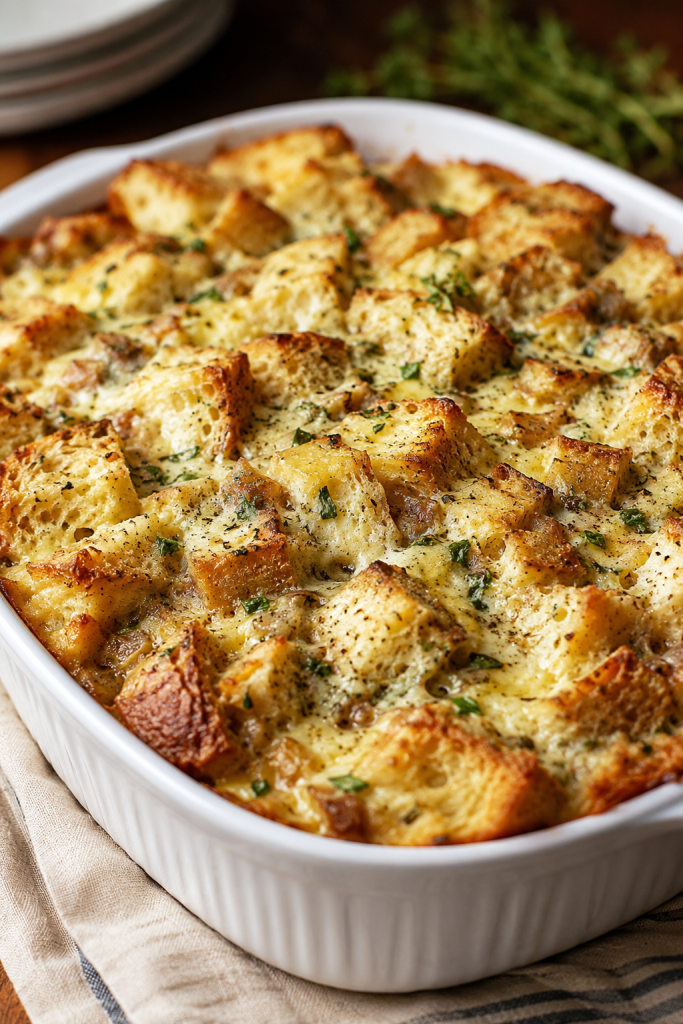
- The top is deeply golden brown with darker golden patches of caramelised cheese visible across the surface
- The edges are set and pulling slightly away from the sides of the dish
- The centre is just barely set — it should have a very slight jiggle when the dish is gently shaken but should not be liquid or runny
- A knife inserted in the centre should come out clean with no liquid custard attached
If the top is browning too quickly before the centre is set, cover loosely with foil and continue baking. Every oven is different and the timing should be used as a guide rather than an absolute.
Step 7 — Rest, Garnish, and Serve
Remove the bread pudding from the oven and let it rest for 10 to 15 minutes before serving. This resting period is genuinely important — the custard continues to set during resting and the bread pudding firms from a just-barely-set wobble to a cohesive, scoopable consistency that holds together beautifully when served. A bread pudding cut too soon will be slightly runny and fall apart on the plate. One that has rested properly will scoop cleanly and hold its shape on the plate while remaining gloriously custardy inside.
Scatter fresh snipped chives and roughly chopped parsley generously over the golden top immediately before serving. Serve directly from the baking dish at the table — the presentation of a golden-topped, herb-scattered bread pudding in its baking dish is genuinely beautiful and very welcoming. Offer sour cream or crème fraîche and extra Parmesan at the table for those who want additional richness and sharpness.
Cook Tips for the Best Savory Bread Pudding
1. Use day-old or dried bread — never fresh bread. Fresh bread turns the bread pudding dense, heavy, and slightly gummy because it cannot absorb the custard properly without becoming saturated and sodden. Day-old or oven-dried bread absorbs the custard completely and produces the proper custardy-but-structured texture that defines a great bread pudding. This is genuinely one of the most important rules of the recipe.
2. Soak overnight for the best possible result. The minimum soaking time is 1 hour but overnight is the gold standard. Extended soaking allows the custard to penetrate every bread piece from surface to centre, which produces a bread pudding that is evenly custardy throughout rather than custard-soaked on the outside and still dry in the centre. The overnight version is dramatically better in both texture and flavour than a short-soak version.
3. Caramelise the onions properly. Twenty-five to thirty minutes over medium-low heat with patient, occasional stirring is what produces properly caramelised onions. Quick-cooked onions that are pale golden rather than deep amber-brown taste sharp and slightly raw rather than sweet and deeply flavourful. The onions are one of the most important filling components in this recipe — give them the time they need.
4. Use Gruyère as the primary cheese. Gruyère is one of the finest baking and melting cheeses in the world for applications like this. It melts smoothly into the custard, develops a beautifully golden crust on top during baking, and has a nutty, complex flavour that is deeply compatible with egg-based custards. Swiss cheese is the most accessible substitute. Sharp white cheddar or a combination of cheddar and Gruyère also works very well.
5. Grate all cheese fresh from the block. Pre-grated cheese from bags contains anti-caking agents that prevent proper melting into the custard and can create a slightly grainy texture in the finished bread pudding. Freshly grated cheese from a block melts completely and smoothly into the custard and produces a cohesive, silky interior texture. Take the extra few minutes to grate everything fresh.
6. Press the bread into the custard after pouring. After the custard is poured over the assembled bread pudding, use clean hands or a large spoon to press all the bread pieces gently down into the liquid. This ensures every piece has initial contact with the custard and begins absorbing from the moment it is assembled. Pieces left floating above the custard surface will not soak as efficiently during the refrigeration period.
7. Season the custard boldly. The custard is the primary seasoning vehicle for the entire dish — it permeates every piece of bread and every element of the filling during soaking and baking. A timidly seasoned custard produces a timidly seasoned bread pudding regardless of how well-seasoned the individual filling components were. Taste the custard before pouring and make sure it tastes confidently savoury, well-peppered, and pleasantly salty.
8. Bring the bread pudding to near room temperature before baking. Thirty minutes out of the refrigerator before it goes in the oven allows the very cold centre to begin warming, which means the oven heat can cook through the full depth of the dish more evenly. A cold bread pudding placed directly in a hot oven takes significantly longer to cook through and can result in an overcooked top and undercooked centre.
9. The jiggle test is your most reliable doneness indicator. A properly baked savory bread pudding will have a very slight jiggle in the very centre when the dish is gently shaken — similar to how a properly baked cheesecake jiggles. If the entire surface jiggles like liquid, it needs more time. If there is no jiggle anywhere, it may be slightly over-baked. The slight jiggle in the centre indicates that the custard has just barely set and will firm to the perfect consistency during the resting period.
10. Do not skip the Parmesan on top. The Parmesan scattered over the top before the uncovered baking period creates a deeply golden, slightly crunchy, intensely savoury crust that is the crowning feature of the finished bread pudding. Parmesan has the lowest moisture content of any common cheese and it crisps and browns at oven temperatures faster and more completely than any other widely available cheese. It is irreplaceable as a bread pudding topping.
How to Store and Reheat Leftovers
In the fridge: Savory Bread Pudding stores exceptionally well and is one of the finest leftover dishes imaginable. Cover the baking dish tightly with plastic wrap or transfer individual portions to airtight containers. Refrigerate for up to 4 days. The bread pudding actually improves in flavour over the first 24 to 48 hours as the filling components continue to meld with the custard and the overall flavour deepens and becomes more cohesive.
In the freezer: Individual portions of savory bread pudding freeze very well for up to 3 months. Wrap each portion tightly in plastic wrap and then in aluminium foil, or place in freezer-safe containers. Thaw overnight in the refrigerator before reheating. Label with the date. Freezing the entire baking dish is also possible — cover tightly with plastic wrap and then foil and freeze for up to 2 months.
How to reheat individual portions: The best method is the oven. Place individual portions in a small baking dish, cover with foil, and reheat at 325 degrees Fahrenheit for 15 to 20 minutes until warmed through. Remove the foil for the final 5 minutes to allow the top to re-crisp slightly. You can also reheat in a skillet over medium-low heat — place the portion cut-side down in a lightly buttered pan, cover with a lid, and warm for 5 to 6 minutes until heated through. This method produces a lovely, slightly crispy bottom on the reheated portion. Microwave reheating works in a pinch but softens the top crust — use a covered bowl and heat in 90-second intervals, checking between each.
Reheating the whole dish: Cover the dish with fresh aluminium foil and reheat at 325 degrees Fahrenheit for 25 to 30 minutes until heated through. Remove the foil for the final 8 to 10 minutes and add a fresh scattering of Parmesan over the top to refresh the golden crust.
What to Serve With Savory Bread Pudding
As a main dish:
- A simple green salad with a sharp lemon vinaigrette — the fresh acidity cuts through the richness of the custard beautifully and provides the clean, light contrast that a rich main dish always benefits from
- Roasted cherry tomatoes with fresh basil and olive oil — the bright acidity and sweetness of roasted tomatoes pairs naturally with the savoury, eggy custard
- A light, bright cucumber and herb salad dressed with white wine vinegar — cool, crisp, and refreshing alongside the warm, rich bread pudding
- Sautéed greens — wilted kale or Swiss chard with garlic and a squeeze of lemon — provides a slightly bitter, nutritious counterpoint to the indulgent richness of the main dish
As a side dish:
- Alongside roast chicken — savory bread pudding is a magnificent substitute for traditional stuffing alongside a roast and actually shares much of its DNA with classic bread stuffing
- With braised beef short ribs — the custardy bread pudding soaks up the braising liquid beautifully and the combination is deeply luxurious
- Alongside a simple roasted pork tenderloin — the herby, cheesy bread pudding is a wonderful companion to the clean, lean flavour of pork
Ways to Customise This Recipe
Make it with smoked salmon and cream cheese: Replace the bacon with 6 ounces of hot-smoked salmon, flaked into large pieces, and replace the cheddar with 4 ounces of cream cheese broken into small pieces and scattered through the layers. Add 2 tablespoons of capers and 2 tablespoons of fresh dill to the filling. Omit the mushrooms and replace with thinly sliced fennel, which pairs beautifully with smoked salmon. The result is an extraordinarily elegant, deeply flavourful savory bread pudding that is perfect for a special brunch.
Make it with roasted vegetables and goat cheese: Omit the bacon and replace with 2 cups of roasted mixed vegetables — zucchini, aubergine, red onion, and red pepper roasted in olive oil and garlic until deeply golden. Replace the Gruyère with 5 ounces of crumbled fresh goat cheese scattered through the layers. The goat cheese melts into the custard and gives it a tangy, creamy quality that contrasts beautifully with the sweet roasted vegetables. This version is outstanding as a vegetarian main course.
Make it with Italian sausage and sun-dried tomatoes: Replace the bacon with 8 ounces of Italian sausage, removed from its casing and browned in large, irregular pieces. Add half a cup of oil-packed sun-dried tomatoes, drained and roughly chopped, and half a cup of pitted black olives to the filling. Replace the Gruyère with fontina cheese. The result has a boldly Italian character that is deeply satisfying and works beautifully as a main course alongside a simple green salad.
Make a French onion soup inspired version: Use sourdough bread specifically and replace the vegetable filling with a very large batch of deeply caramelised onions — double the quantity in the original recipe — cooked until deeply golden and slightly jammy. Replace the cream with beef broth for part of the custard liquid — use 1 cup of heavy cream and 1 cup of good quality beef broth for a deeper, more savoury custard with a slightly beefy quality. Top generously with Gruyère and Parmesan. The result tastes remarkably like a French onion soup in bread pudding form and is absolutely outstanding.
Frequently Asked Questions
1. Can I use sandwich bread instead of crusty bread for this recipe?
You can, but the result will be noticeably different in texture. Sandwich bread has a much softer, finer crumb than crusty sourdough or country bread, and it absorbs the custard more rapidly and more completely. The finished bread pudding made with sandwich bread will be denser, softer throughout, and without any of the textural variation — the slightly crunchy top, the custardy middle, the denser bottom — that makes crusty bread bread pudding so interesting. If sandwich bread is all you have, dry it thoroughly, use it, and expect a softer, more uniform result. For the best possible bread pudding, use the crustiest, most open-crumbed bread you can find — sourdough, ciabatta, or a good French country loaf.
2. Can I make this recipe dairy-free?
Yes with some substitutions that work reasonably well. Replace the heavy cream with full-fat coconut cream — it has a similar fat content and produces a rich custard though with a slight coconut flavour that is more noticeable in a savoury context than a sweet one. Replace the whole milk with unsweetened oat milk or full-fat oat milk for the closest texture match. Replace the butter with a good quality dairy-free butter. Dairy-free cheese alternatives vary significantly in quality — look for brands that specify they are made for melting. The result will be different in flavour from the full-dairy version but still very good.
3. My bread pudding is soggy in the centre after the full baking time. What went wrong?
A soggy centre in a baked custard dish is almost always caused by one of three things. The most common is underbaking — the custard needs to set all the way through the depth of the dish and in a deep 9×13 inch dish this takes the full covered and uncovered baking time. The second cause is taking the dish straight from the refrigerator to the oven without the 30-minute room temperature rest — a very cold centre takes much longer to cook through. The third is using too much liquid relative to bread — if the bread was fresh rather than dry it may not have absorbed enough of the custard during soaking and excess liquid pooled at the bottom of the dish. If you find the centre still soggy at the end of the baking time, recover with foil and bake in 10-minute increments until the jiggle test shows only a very slight movement in the very centre.
4. Can I make this as individual portions in ramekins rather than one large dish?
Yes, and individual ramekins are a beautiful and practical option especially for dinner party serving. Butter the ramekins generously and fill them three-quarters full with the assembled bread and filling mixture. Pour the custard over each until it reaches just below the rim. Refrigerate for the same soaking period. Bake at 325 degrees Fahrenheit — individual portions bake faster than a large dish — uncovered for 25 to 30 minutes until the tops are golden and the custard is just set with a slight jiggle. Individual portions can be unmoulded onto plates for a more formal presentation or served directly in the ramekins for a more casual, rustic look.
5. What is the best bread for savory bread pudding and does the type really matter?
The type of bread genuinely matters quite significantly for the final result. Sourdough is the most recommended choice — its slightly tangy flavour adds complexity to the savoury custard, its open, irregular crumb absorbs the custard well while maintaining structure, and its crust toasts beautifully. French baguette gives a more neutral flavour with excellent structure and absorption. Ciabatta has an open, airy crumb that absorbs the custard very readily and produces a particularly light, custardy interior. Brioche, while usually associated with sweet bread pudding, actually works beautifully in a savoury version — its richness and slight sweetness adds an unexpected luxury to the custard. Avoid plain white sandwich bread, whole wheat bread with a very dense crumb, or any bread with strong competing flavours like rye. The best breads are those with an open crumb, a good crust, and a neutral to slightly tangy flavour.
Conclusion
Savory Bread Pudding is one of those recipes that reveals itself to be far more extraordinary than its humble description initially suggests. At its core it is just bread and eggs and cream — ingredients so fundamental and so widely available that they barely register as special on their own. But combined with the right technique, the right flavourings, and the patience that proper caramelised onions and an overnight soak require, they transform into something that is genuinely spectacular — rich and custardy and deeply savoury with a golden, slightly crispy top and a filling that reveals layers of smoky bacon, sweet caramelised onions, earthy mushrooms, wilted spinach, and melted Gruyère in every scoop.
What makes this recipe so particularly satisfying to make and to share is its versatility. It works beautifully as the centrepiece of a celebratory brunch that feels genuinely impressive without requiring an early start in the kitchen — make it the night before, soak it overnight, and bake it in the morning. It works as a comforting, hearty weeknight dinner served with a simple salad. It works as a stunning side dish alongside a roast. And it makes some of the finest leftovers of any dish in this entire collection — reheating to near-original quality with just a few minutes in the oven and improving in flavour with each passing day.
Take the time to dry your bread properly, caramelise those onions all the way, soak overnight without exception, and season the custard boldly before it goes over the bread. Do those things and you will produce a savory bread pudding that is genuinely memorable — the kind of dish that people ask you about, ask you for the recipe of, and remember long after the meal is finished. Serve it generously, pass the Parmesan, and enjoy every rich, custardy, golden, deeply satisfying bite!